Section 1 · Reading Comprehension
In the real ASET you'll read passages and answer questions on main idea, inference and vocabulary — about one minute per question.
THE LIGHTHOUSE KEEPER'S LAST SHIFT
For forty-one years, Edith Marsh climbed the ninety-seven steps of the Point Carey lighthouse twice a day. She had outlasted three head keepers, two cyclones and one government inquiry that had recommended — in polite, typewritten paragraphs — that the light be automated. Tonight, the recommendation had finally become an instruction. A technician from the city had installed a small grey box that would do her job forever, without tea breaks and without complaint. Edith polished the great lens one last time, though no one had asked her to. "Machines keep the light burning," she told the empty stairwell, "but they don't keep watch." Below, the sea went on saying the only thing it ever said.
Question 1
Why does Edith polish the lens even though "no one had asked her to"?
- AShe hopes the inquiry will change its decision if the lighthouse is well kept.
- BThe technician instructed her to prepare the lens for automation.
- CIt is a final act of pride and care in a job that has defined her life.
- DShe does not trust the grey box to switch the light on that night.
Answer: C. The passage stresses her 41 years of devotion and her belief that keeping watch means more than keeping the light burning. Polishing the lens unasked is symbolic care, not a practical or requested act — so A, B and D all add motives the text never supports.
Question 2
Edith's remark that machines "don't keep watch" suggests she believes:
- Athe grey box will frequently break down in bad weather.
- Ba keeper offers human attention and judgement that automation cannot replace.
- Cthe government inquiry was carried out dishonestly.
- Dlighthouses are no longer necessary for modern ships.
Answer: B. This is an inference question. Edith accepts that machines can keep the light burning (their technical job) but contrasts this with "keeping watch" — the human vigilance she provided. She never claims the machine will fail (A), attacks the inquiry's honesty (C), or dismisses lighthouses (D).
Question 3
In the final sentence, "the sea went on saying the only thing it ever said" is best understood as:
- Aa literal description of voices carrying across the water.
- Ba hint that a storm is about to strike the lighthouse.
- Cevidence that Edith is beginning to imagine things.
- Dpersonification showing the sea's indifference — it continues unchanged while Edith's world changes completely.
Answer: D. The sea is given a human action ("saying") — personification. Its unchanging repetition contrasts with the upheaval in Edith's life, underlining that nature is indifferent to human change. Nothing signals literal voices, a storm, or hallucination.
Section 2 · Quantitative Reasoning
ASET quantitative questions are multi-step problems — ratios, percentages, timetables and logical deduction — not just arithmetic.
Question 4
A recipe uses flour and sugar in the ratio 5 : 2. Maya bakes a full batch using 350 g of flour, then bakes a second batch that is half the size of the first. How much sugar does she use in total?
- A140 g
- B175 g
- C210 g
- D280 g
Answer: C. Ratio 5 : 2 means sugar = (2 ÷ 5) × flour. First batch: 350 ÷ 5 = 70, so sugar = 2 × 70 = 140 g. Half-size batch: 70 g of sugar. Total = 140 + 70 = 210 g. Option A is the trap for stopping after the first batch.
Question 5
A ferry departs every 40 minutes. The first ferry of the day leaves at 8:20 am. Lena arrives at the wharf at 11:05 am. How long does she wait for the next ferry?
- A15 minutes
- B25 minutes
- C35 minutes
- D40 minutes
Answer: C. List the departures: 8:20, 9:00, 9:40, 10:20, 11:00, 11:40. Lena arrives at 11:05 — she has just missed the 11:00 ferry. The next is 11:40, so she waits 35 minutes. Writing out the timetable beats trying to divide in your head.
Question 6
Four friends finished a running race. Tom finished before Sara but after Amy. Ben finished last. Who came second?
- AAmy
- BTom
- CSara
- DIt cannot be determined
Answer: B. "Tom before Sara but after Amy" gives the chain Amy → Tom → Sara. Ben is last, so the full order is Amy, Tom, Sara, Ben — Tom is second. For ordering puzzles, always sketch the chain rather than juggling it mentally.
Question 7
A bookshop reduces a $48 book by 25% in a sale. A member's card then takes a further $3 off the sale price. What does a member pay?
Answer: B. 25% of $48 = $12, so the sale price is $36. The member pays $36 − $3 = $33. Watch the order of operations: the $3 comes off after the percentage, not before.
Section 3 · Abstract Reasoning
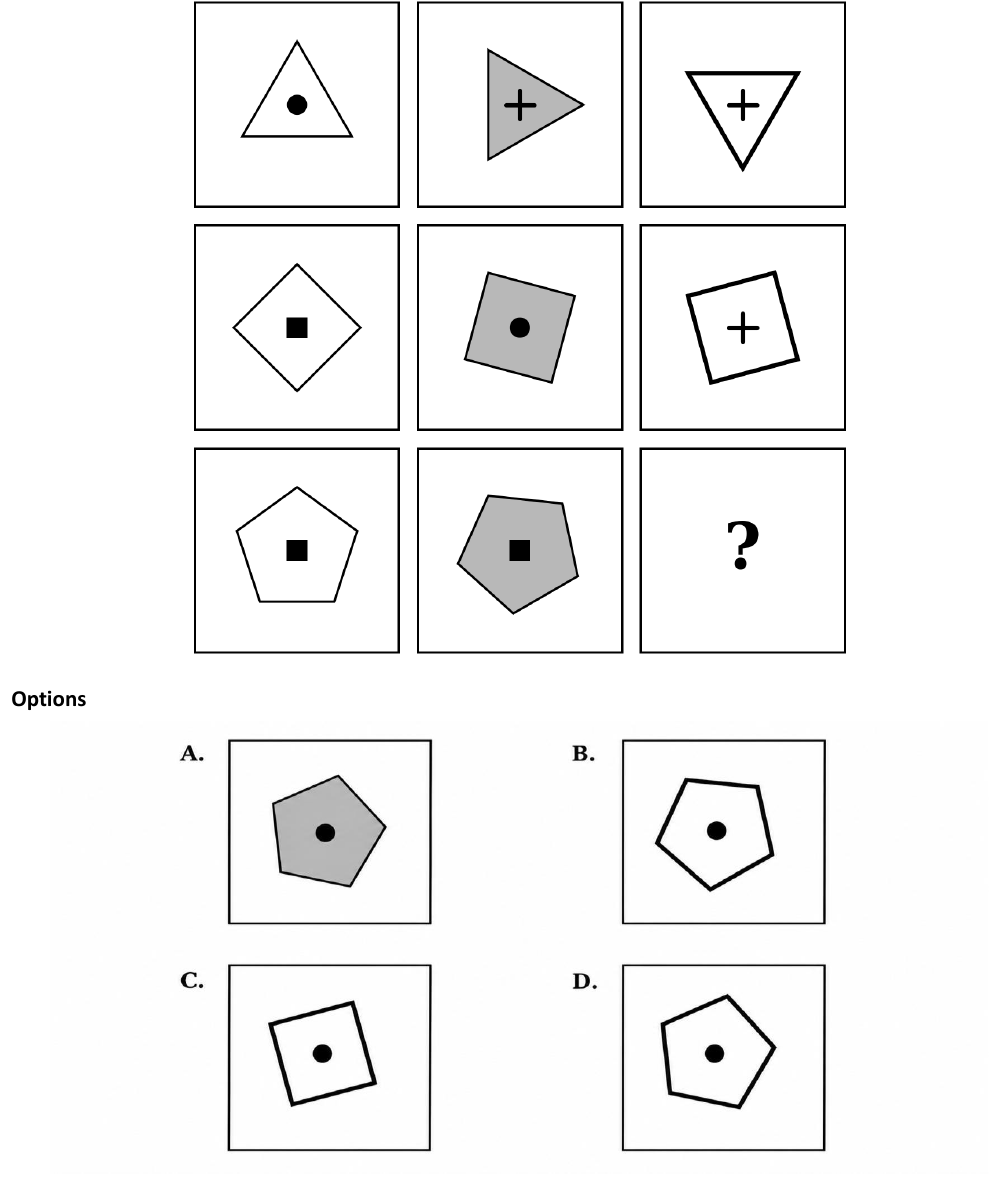
Abstract reasoning uses shapes and figures — work out the rules governing the 3×3 grid, then choose the option that completes it. These three questions are taken directly from our Advanced Abstract Reasoning set.
Question 8 · Complete the Pattern
Which option (A–D) most logically completes the grid?
- AOption A
- BOption B
- COption C
- DOption D
Answer: D. Four rules run at once: the polygon gains sides down the rows (triangles → squares → pentagons); it rotates 30° more per column; column 1 is plain, column 2 grey-filled, column 3 thick-outlined; and the inner symbol depends on position — a dot on the diagonal, a plus above it, a square below it. The missing cell (row 3, column 3) must be a pentagon, rotated 60°, thick outline, with a dot — only D. A has column-2's grey fill, B uses column-2's rotation, C is a square.
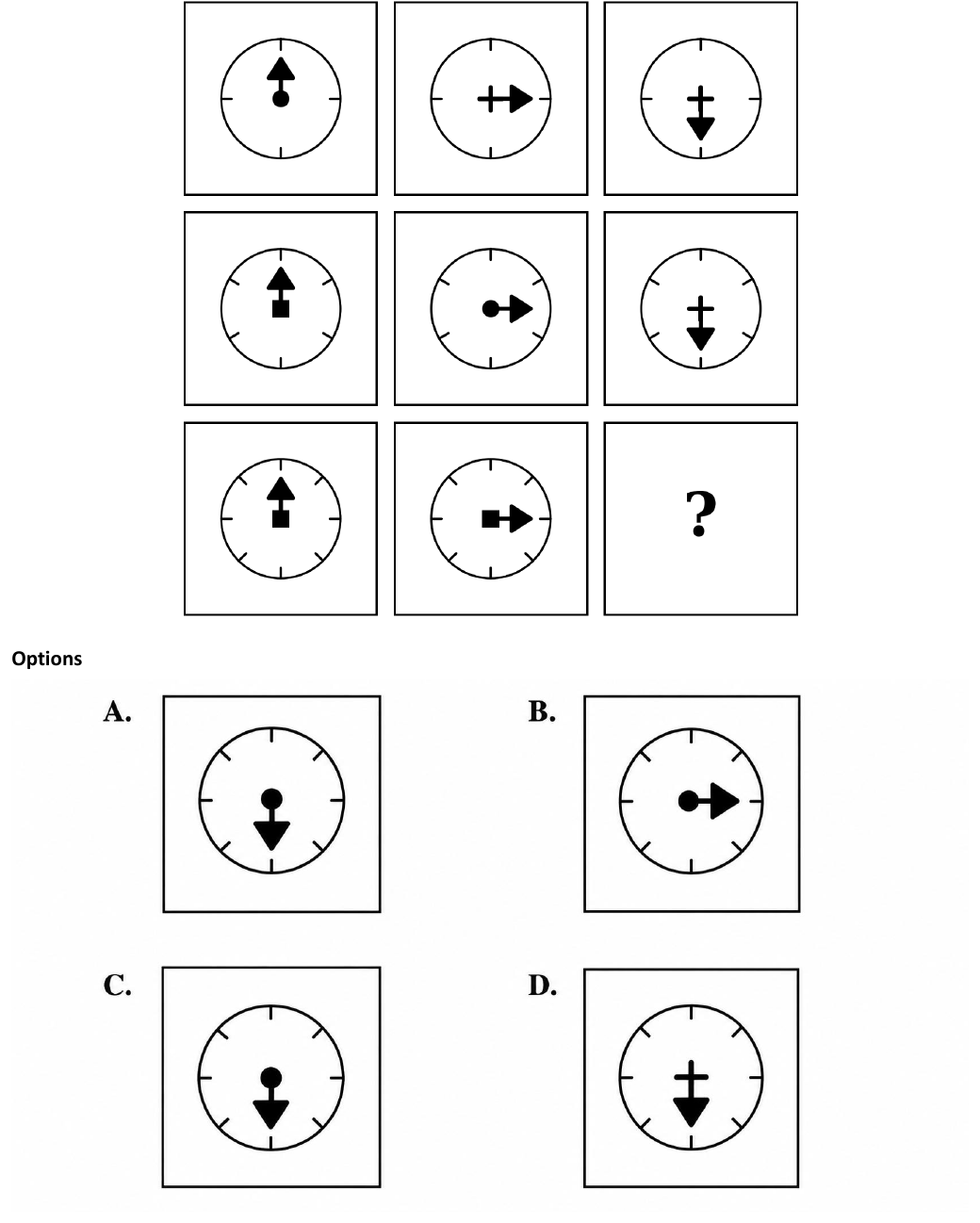
Question 9 · Complete the Pattern
Which option (A–D) most logically completes the grid?
- AOption A
- BOption B
- COption C
- DOption D
Answer: A. Three rules: the tick marks around each circle are set by the row (4, then 6, then 8); the pointer rotates 90° clockwise per column (up → right → down); and the central symbol follows the diagonal rule (dot on the diagonal, plus above, square below). The missing cell needs 8 ticks, a downward pointer and a central dot — only A has all three. B points the wrong way, C has only 6 ticks, D swaps the dot for a plus.
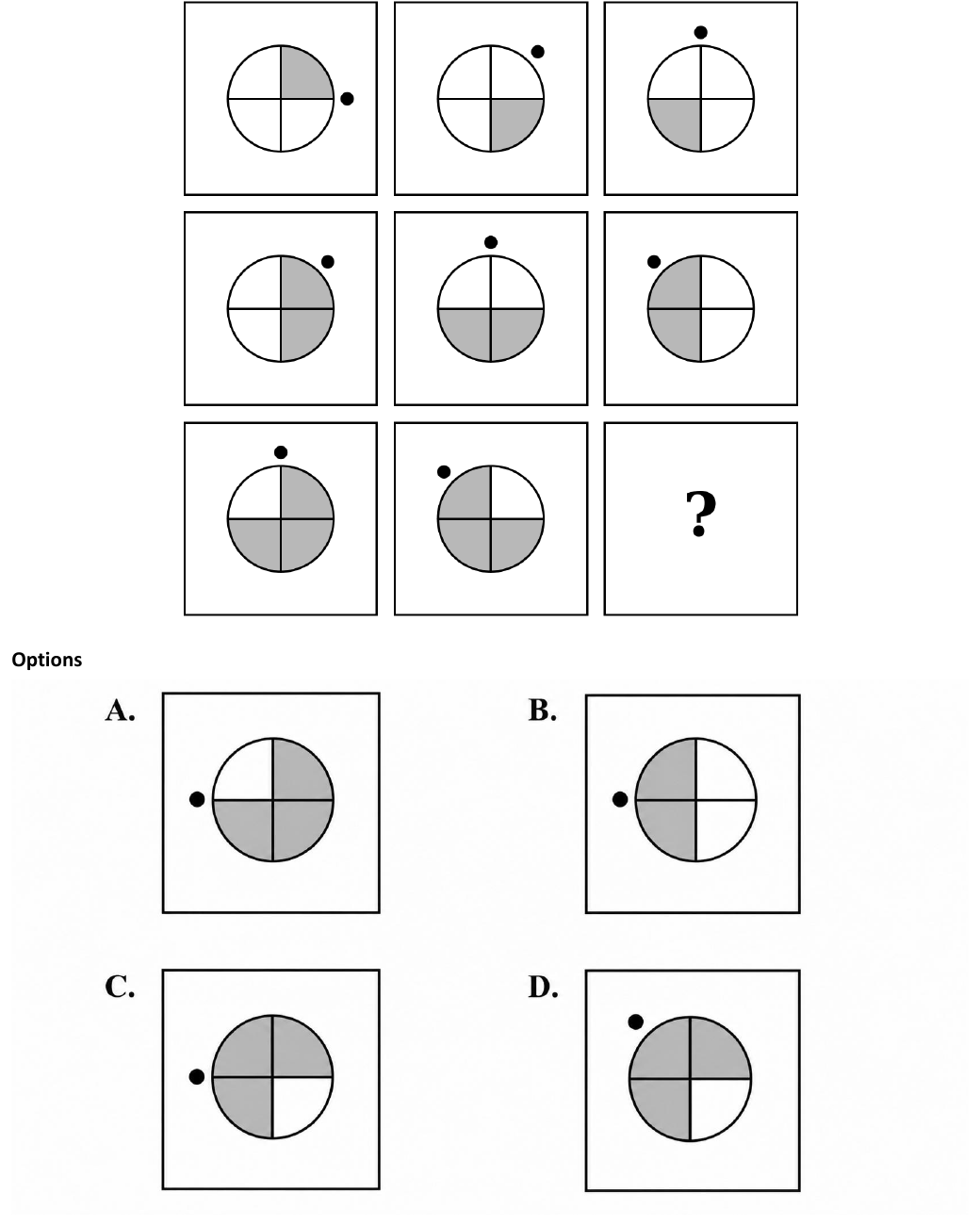
Question 10 · Complete the Pattern
Which option (A–D) most logically completes the grid?
- AOption A
- BOption B
- COption C
- DOption D
Answer: C. The number of shaded quadrants equals the row (1, 2, then 3), shading clockwise; the starting quadrant rotates 90° clockwise per column; and the satellite dot sits at 45° × (row + column − 2) counter-clockwise from east. Row 3, column 3 needs three quadrants shaded from the bottom-left and the dot due west — that's C. A starts in the wrong quadrant, B shades only two, D places the dot at 135°.
Section 4 · Written Expression
The ASET ends with a timed creative writing task. There's no multiple choice here — set a 25-minute timer and try this prompt under real conditions.
Practice Writing Prompt · 25 minutes
At the end of the school library there is a door that nobody has ever opened. Today, it is slightly ajar. Write a story about what happens next. Build tension, use the senses, and end with a moment that surprises the reader.
How markers assess GATE writing
Strong responses spend 5 minutes planning (character, problem, ending), slow down at one dramatic moment with sensory detail, use varied sentence lengths, and finish with a controlled ending — not "it was all a dream". Accuracy matters: leave 3 minutes to fix punctuation and repeated words.
Want structured feedback on your child's writing? Our ASET writing guide breaks down the full 25-minute method.